 |
All
releases > Profiles of Canadian farm operators
>
Young operators most likely to have a non-farm job
Non-farm work on the rise, especially among the
young
When receipts rise, non-farm work drops
Men work more hours on the farm
If you're a farm operator, age and receipts influence whether or not
you'll also have a non-farm job.
- If you're a farmer under 35 years old, you're more likely than older
operators to have a job that doesn't involve farming on top of your
farm work.
- If you're an operator on a farm that generates more than $100,000
in gross farm receipts, you're half as likely to have a non-farm job
as someone whose farm receipts are less than $25,000.
- And if you're female and running a horse and pony farm (the farm type
where women operators are best represented) there's a one in two chance
that you'll also be doing some kind of non-farm work.
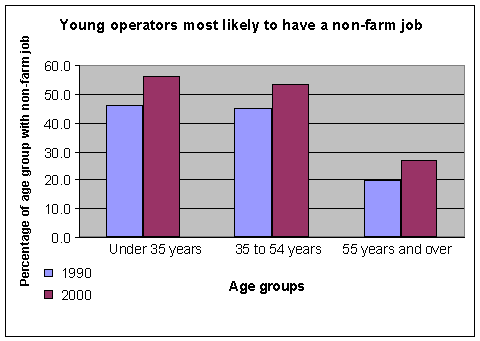
Non-farm work on the rise, especially among the young
The non-farm work of all farm operators is increasing, but its extent
has increased most in the youngest group. For this group, the proportion
working at another job has gone from 46% to 56% in a decade.
Not only are young farmers more likely to work off the farm but nearly
half of them clocked more than 40 hours per week at non-farm work, compared
with only 30% of those farm operators over 55.
Both men and women have increased their rate of working off the farm
since 1990, and roughly equal proportions of women farm operators (45.6%)
and men (44.2%) worked at non-farm jobs in 2000.
| The Census of Agriculture asks farm operators
to report their average time contribution to the operation of their
farm. If they work at another job or operate another business, the
census asks for that time contribution as well. The census also recognizes
that there is another component to life that is a significant part
of the work that farm operators, particularly women, do every day.
Unpaid family labour — taking care of children, making meals,
doing housework — all take time and are all a necessary underpinning
to the operation of a farm and a family. |
Even though men and women report about the same rate of non-farm work,
women work fewer hours at non-farm employment than men. Only 23% of women
who have non-farm work put in more than 40 hours per week, compared with
46% of men.
| |
Male operators |
Female operators |
All operators |
Non-farm work
(2000) |
Number |
Proportion (%) |
Number |
Proportion (%) |
Number |
Proportion (%) |
| Less than 20 hours |
18,905 |
16.8
|
11,180
|
26.9
|
30,085
|
19.5 |
| 20 to 40 hours |
42,260 |
37.5 |
21,010 |
50.5 |
63,265 |
41.0 |
| More than 40 hours |
51,435 |
45.7 |
9,425 |
22.7 |
60,865 |
39.5 |
| Total |
112,610 |
100.0 |
41,605 |
100.0 |
154,225 |
100.0 |
The seasonal aspect of some farming, such as crop farming, is more compatible
with another job. For farmers in livestock operations, especially dairy,
it is more difficult to juggle this arrangement. Specialty or other types
of livestock, such as horse and pony and sheep farms are the farm types
most likely to have operators reporting non-farm work.
When receipts rise, non-farm work drops
Not surprisingly, the incidence of non-farm work among all age groups
decreases as a farm’s gross farm receipts increase, with the $100,000
threshold marking a dramatic turning point. As receipts increase beyond
a half-million dollars, the proportion of operators working at non-farm
work dwindles to less than 16%.
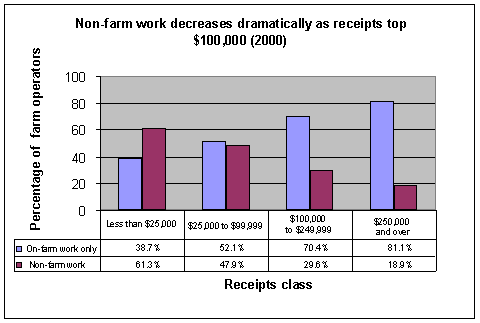
Over 60% of operators on farms with receipts less than $25,000 reported
non-farm work. Nearly one-half of them work more than 40 hours a week
at non-farm jobs.
Men work more hours on the farm
Your sex can have an impact on how many hours you work, both on and off
the farm.
Women tend to work fewer hours per week on the operation of the farm
than men. Just over 30% of women work more than 40 hours per week on the
farm, compared with 54% of men. Only 21% of men work fewer than 20 hours
on the farm, compared with 38% of women.
| |
Male operators |
Female operators |
All operators |
On-farm work
(2000) |
Number |
Proportion (%) |
Number |
Proportion (%) |
Number |
Proportion (%) |
| Less than 20 hours |
53,610 |
21.0 |
34,440 |
37.8 |
88,040 |
25.4 |
| 20 to 40 hours |
64,180 |
25.2 |
28,765 |
31.5 |
92,950 |
26.8 |
| More than 40 hours |
137,225 |
53.8 |
27,975 |
30.7 |
165,200 |
47.7 |
| Total |
255,020 |
100.0 |
91,175 |
100.0 |
346,200 |
100.0 |
Additional profiles on the provinces, women farm operators, and operator
injuries are available at Profiles of Canadian farm operators. Tables
with more provincial detail about farm operators, including their median
age and sex, on- and non-farm work, injuries, and distribution by farm
type, gross farm receipts, and farm capital are available at Canadian Statistics.
The complete set of data on farm operators, including distribution by
age class, is now available at the county, municipality and regional district
levels (or their equivalents) in Farm operator data: initial release (95F0355XIE,
free) on Statistics Canada's Web site (). From the Our products
and services page choose Free publications then Agriculture.
For more information, or to enquire about the concepts, methods or data
quality of this release, contact Gaye Ward (613-951-3172), Census of Agriculture,
or Media Relations (613-951-4636).
|



