 |
All
releases > Profiles of Canadian farm operators
>
Who’s minding Saskatchewan’s farms?
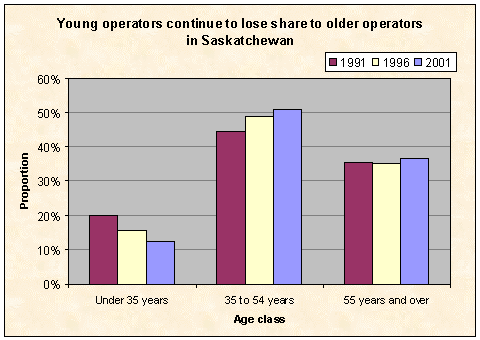
Distribution of farm operators in Saskatchewan
by age class, 1991 to 2001
Other highlights
The number of farm operators in Saskatchewan declined 9.1%, from 72,925
in 1996 to 66,275 in 2001. Only Alberta and British Columbia had smaller
percentage decreases in farm operators. The decrease in Saskatchewan’s
farm operators is similar to the 11.2% decline in the number of farms
reported on May 15, 2002 in Farm operations: regional trends.
Dividing the farm operator population into three age categories —
under 35 years, 35 to 54 and 55 and over — shows clear trends. Although
all three have declined in number since the last census, the change in
the youngest group (which includes operators from 15 years of age to 34)
is dramatic and casts an increasingly large and grey shadow over farming’s
future. From 1996 to 2001, the number of operators under 35 decreased
by 28.6%. Since 1991, operators in this group dropped by almost half.
Another way to look at the whole picture is to consider the shares held
by each age group. As the share of the younger group shrinks from census
to census, the two older groups tend to increase or stay relatively the
same: 51.1% are now between the ages of 35 and 54, and those 55 and over
represent 36.7%. The youngest group represents 12.3% of all farmers; 10
years ago it was one-fifth. Whether the picture is viewed in absolute
or relative terms, farm operators are a greying population.
A comparable group of self-employed workers under 35 in the general labour
force constitutes 17.2% of all self-employed workers in Saskatchewan.
This is a marked difference from the 12.3% of farm operators under 35.
Distribution of farm operators in Saskatchewan by age
class, 1991 to 2001
| |
1991 |
1996 |
2001 |
% change 1991 to 2001 |
% change 1996 to 2001 |
| |
Number |
Proportion
(%) |
Number |
Proportion
(%) |
Number |
Proportion
(%)
|
|
Under 35 years |
15,635 |
20.0 |
11,400 |
15.6 |
8,135 |
12.3 |
-48.0 |
-28.6 |
35 to 54 years |
34,800 |
44.6 |
35,785 |
49.1 |
33,850 |
51.1 |
-2.7 |
-5.4 |
55 years and over |
27,590 |
35.4 |
25,740 |
35.3 |
24,290 |
36.7 |
-12.0 |
-5.6 |
Total operators
|
78,025 |
100.0 |
72,925 |
100.0 |
66,275 |
100.0 |
-15.1 |
-9.1 |
A further indication of an aging farm population in Saskatchewan is the
increase in the median age of farm operators. The median age increased
from 48 years in 1996 to 49 in 2001. In addition, of all the farm operators
counted on May 15, 2001, 18.2% were 65 or over. Another 12,205, or 18.4%,
will celebrate their 65th birthday by 2011. By contrast, 9.9% of the entire
labour force will turn 65 by the 2011 Census.
Additional profiles on the other provinces, and on women farm operators,
operator injuries, and on- and non-farm work are available at Profiles of Canadian farm operators. Tables with more provincial detail about farm
operators, including their median age and sex, on- and non-farm work,
injuries, and distribution by farm type, gross farm receipts, and farm
capital are available at Canadian Statistics.
Other highlights
In 2001, 66,275 farm operators were on 50,598 farms in Saskatchewan.
Single-operator farms accounted for 69.8% of all farms, while same-generation
farms accounted for 25.0%, and multiple-generation farms made up the
remaining 5.2%. (Operators must have at least 20 years difference in
age but not necessarily be related to be considered of a different generation.) The proportion of female farm operators in Saskatchewan increased
to 22.3% in 2001, from 20.0% in 1996. Saskatchewan had the lowest female
proportion of any Prairie province, but has closed the gap with Manitoba,
which had 22.6%. In 2001, the median age of male operators in Saskatchewan was 50
years, an increase of two years from 1996. Nationally, the median age
of male operators was 49 years in 2001. The median age for female operators
moved to 48 from 46 in 1996. This was the same median age as the national
level for female operators. In the last 12 months before the census, 2,410 farm operators in Saskatchewan
— or 3.6% — suffered a farm-related injury requiring medical
attention or resulting in lost time. Saskatchewan had the second highest
injury rate in Canada; only Manitoba was higher, with 4.0%. The national
injury rate was 3.2%. The most common injuries suffered by Saskatchewan farm operators
were open wounds (19.7%), fractures (18.0%), and nerve and spinal cord
injuries (17.4%). The proportion of farm operators in Saskatchewan working more than
40 hours on the farm in 2000 remained almost unchanged at 53.0%. The
proportion of farm operators in Saskatchewan is still above the national
average of 47.7% for on-farm work of more than 40 hours per week. In 2000, 49.4% of all female operators in Saskatchewan engaged in
non-farm work in addition to their work on the farm, compared with 41.6%
of their male counterparts. This was the second lowest male proportion
in Canada. Nationally, 45.6% of female and 44.2% of male operators had
some non-farm work. Saskatchewan farm operators under 35 were three times as likely to
have non-farm work compared with operators 55 and over in 2000. Of those
under 35, 66.4% had some non-farm work, compared with only 20.1% of
operators 55 and over.
The complete set of data on farm operators, including distribution by
age class, is now available at the county, municipality and regional district
levels (or their equivalents) in Farm operator data: initial release
(95F0355XIE, free) on Statistics
Canada’s Web site (). From the Our products and
services page choose Free publications then Agriculture.
For more information, or to enquire about the concepts, methods or data quality of this release, contact Gaye Ward (613-951-3172), Census of Agriculture, or Media Relations (613-951-4636).
Require assistance or advice on 2001 Census of Agriculture Products and
Services? Contact the nearest Statistics
Canada Regional Reference Centre.
|



