
Estimating infrastructure investment

Archived Content
Information identified as archived is provided for reference, research or recordkeeping purposes. It is not subject to the Government of Canada Web Standards and has not been altered or updated since it was archived. Please "contact us" to request a format other than those available.
The investment disaggregation is accomplished using a variety of sources, the most important being the Capital and Repair Expenditures Survey, the Government Finance Statistics and detailed customs based international import and export data. These surveys / statistical programs provide considerable asset detail that can be used to split out the more aggregated level investment estimates found in the Canadian supply and use tables and the Canadian Capital Stock account into the disaggregated infrastructure detail. The data will be developed at the provincial/territorial level and aggregated to Canada.
The decomposition of the aggregates into their more detailed components involves four steps:
- extracting the key aggregates related to infrastructure already captured by the macro level accounts such as the Canadian supply and use tables,
- decomposing the aggregates extracted in step one to a sufficient level of detail that will permit mapping to the infrastructure classification systems
- overlaying the infrastructure classification system noted above and
- aggregating the data according to this
This method is illustrated below by way of an example.
Assume that the supply and use tables contain an aggregate estimate of $10 billion for gross fixed capital formation (GFCF) in non-residential buildings for a given province. According to the infrastructure definition noted above, non-residential structures used to deliver health and education services should be included in the estimate of infrastructure assets. Assume that the main data sources used to construct the aggregate measure of $10b GFCF was general government investment flows obtained from government finance statistics (GFS) and investment flows obtained from the capital repair and expenditures survey (CAPEX). The government finance statistics (GFS) contain unpublished detailed information related to provincial government investment in non-residential structures in the health and education sectors and the capital and repair expenditures survey (CAPEX) contains unpublished detailed information related to private investment (mainly non-profit institutions serving households for this example) in non-residential investment in education.
Assume that the concept of capital expenditure in these two data sources conceptually aligns with the concept of gross fixed capital formation in the supply and use tables. The supplementary detail in the GFS indicates that governments invested $2 billion in non-residential structures related to health, $0.5 billion in non-residential structures related to education and $6 billion on all other non-residential structures. Further, assume that CAPEX reported $0.5 billion of non-residential investment spending related to health and $3 billion in all other non-residential non-government investment. Finally, assume that the GFS and CAPEX encompass the universe of non-residential investment in Canada. In order to calculate gross fixed capital formation in health and educational structures we can calculate ratios from the GFS and CAPEX investment data that can be used to estimate gross fixed capital formation in health and educational structures. This is illustrated in the following table.
| Investment Detail | $billions | % Share | Supply and Use Benchmark - GFCF | GFCF by detailed asset category |
|---|---|---|---|---|
| GFS | ||||
| Health | 2 | .. | .. | .. |
| Education | 0.5 | .. | .. | .. |
| Other | 6 | .. | .. | .. |
| CAPEX | ||||
| Health | 0.5 | .. | .. | .. |
| Other | 3 | .. | .. | .. |
| Combined | ||||
| Health | 2.5 | 21% | .. | 2.1 |
| Education | 0.5 | 4% | .. | 0.4 |
| Other | 9 | 75% | .. | 7.5 |
| Total | 12 | 100% | 10 | .. |
The data sources are combined to develop shares of each type of assets, these shares are applied to the supply-use benchmark total estimate of GFCF to determine the split by type of asset.
This can also be expressed using the following equation:
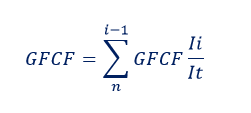
GFCF = Gross Fixed Capital Formation
Ii = in Infrastructure
It = Total Investment
- Date modified: