
Health Fact Sheets
Circumstances surrounding suicide deaths among adults aged 80 years and older in Canada, 2016 to 2023

Text begins
This fact sheet discusses details of suicide which may be triggering to some. If you or someone you know is thinking about suicide, help is available. You are not alone. Call or text 9-8-8. Support is available 24 hours a day, 7 days a week.
End of text boxSummary
Data from the Canadian Coroner and Medical Examiner Database (CCMED) show that among the 80 years and older population who died by suicide from 2016 to 2023:
- Men were nearly 6 times more likely to die by suicide than women.
- Two-thirds of suicide deaths occurred at home.
- Suicidal ideation was reported in over one-third of suicide deaths.
- Deteriorating physical health was the most reported circumstance by coroners and medical examiners, identified for nearly half (47%) of deceased individuals.
- Other reported circumstances included loss of a loved one, loss of mobility, social isolation, family conflict as well as financial or housing insecurity.
Background
Older adults may experience a range of later in life challenges associated with suicide risk, including chronic pain, declining physical and cognitive functioning, bereavement, loneliness, financial strain, and reduced social connectedness (Conejero et al., 2018). Although suicide among older adults is increasingly recognized as an important public health issue, the oldest-old, remain understudied.
According to data from the Canadian Coroner and Medical Examiner Database (CCMED) and the Canadian Vital Statistics Death Database (CVSD), approximately 180 people aged 80 years and older die by suicide each year, representing the 25th leading cause of death for this age group from 2016 to 2023. During this reference period, the age-specific suicide rate for people aged 80 years and older remained relatively stable, fluctuating between 9 and 12 deaths per 100,000 people.
While suicide deaths are more likely to involve men than women, the sex gap in the rate of death by suicide is considerably wider for this older group of Canadians. Based on current data from the CCMED and CVSD, from 2016 to 2023, the rate of suicide among those 80 years and older was nearly 6 times higher among men than women (22.0 versus 3.8 per 100,000 population) – compared to about 3 times higher among men than women (17.8 versus 6.1 per 100,000 population) within the adult population under the age of 80.
Despite the descriptive statistics by age and sex available in existing literature for older age groups, there is limited information on the circumstances surrounding suicide deaths in this population. The following analysis will provide an overview of the coroner and medical examiner reported circumstances surrounding suicide deaths among the population aged 80 years and older.
This health fact sheet provides information on:
- Place of death, suicidal ideation, presence of suicide note, and circumstances surrounding suicide deaths for the adult population aged 80 years and older.
Two-thirds of suicide deaths among adults aged 80 and older occurred in a private home
From 2016 to 2023, two-thirds of suicide deaths among those 80 years and older occurred in a private home. Previous Statistics Canada findings showed that approximately 7 in 10 suicides occurred in a private residence between 2006 and 2014 (Statistics Canada, 2019).
Residential care homes, including nursing homes, long-term care homes, and retirement residences accounted for the second highest proportion of suicides (14%), followed by hospitals (2%) and other locations (e.g., roadways or bodies of water) (12%). The location was not specified for 7% of suicide deaths.
While the private home was the most common location for both males and females, the proportion among males (69%) was higher than among females (57%). In contrast, residential care homes accounted for a larger proportion of suicide death locations among women (22%) compared to men (12%).

Data table for Chart 1
| Location of death | Men | Women |
|---|---|---|
| percent | ||
| Notes: Data were not available for all jurisdictions for all years (see Note to readers). The counts referenced in this chart were rounded to a neighbouring multiple of five. Source: Canadian Coroner and Medical Examiner Database, 2016–2023 (5125) |
||
| Private home | 69 | 57 |
| Residential care home | 12 | 22 |
| Hospital | 1 | 3 |
| Other location of death | 11 | 10 |
| Location of death not specified | 7 | 7 |
Among people aged 80 years and older that died by suicide at home, 36% lived alone, 25% lived with a spouse, and 13% lived with friends/relatives. This distribution varied slightly by sex. The CCMED reported more women (45%) to be living alone at the time of their suicide death compared to men (34%), however information on living arrangement was not specified for 26% of deaths among men and 21% among women. These data are consistent with those from the Census of Population and can be explained by the longer female life expectancy.
Suicidal ideation was reported in more than one-third of suicide deaths among people 80 years and older
Suicidal ideation includes having thoughts, ideas or considerations about suicide. It is strongly associated with suicide risk, with previous research identifying ideation and attempts as important predictors of suicide death (Nock et al., 2008). Evidence of suicidal ideation was identified in 35% of suicide deaths among people aged 80 or older. This includes both previous and recent expressions of suicidal thoughts, suggesting that signs of suicide risk may be evident at different points prior to death. Reports of suicidal ideation were more common among women (40%) aged 80 years and older who died by suicide than men (34%).
A prior suicide attempt was reported among 10% of people aged 80 years and older who died by suicide from 2016 to 2023. This differed by sex with more women having reports of previous suicide attempts (14%) compared to men (9%). Across Canada, 3.1% of adults had attempted suicide at least once in their lifetime (Public Health Agency of Canada, 2023).
Nearly 2 in 5 adults 80 and older who died by suicide had a specified mental health disorder or were reported to have deteriorating mental health
A mental health disorder was reported in CCMED among 38% of people aged 80 years or older who died by suicide from 2016 to 2023, while 7% were reported to have no mental health disorders. Information on mental health was not specified for 55% of suicide deaths among this population. Mental health conditions are among the factors associated with an increased risk of suicide. Previous research has identified depression, substance use disorders, and psychosis as particularly relevant risk factors, while other mental health conditions may also contribute to suicide risk (Bachman, 2018).
Among adults 80 and over with a specified mental health disorder, over half (57%) were reported to have depression, 18% were reported to have multiple disorders, 13% were reported to have poor or declining mental health in general and 9% were reported to have anxiety.
Mental health disorders were more commonly reported among women (48%) aged 80 years and older who died by suicide compared to men (35%). Among both sexes, depression was the most commonly reported mental health disorder.
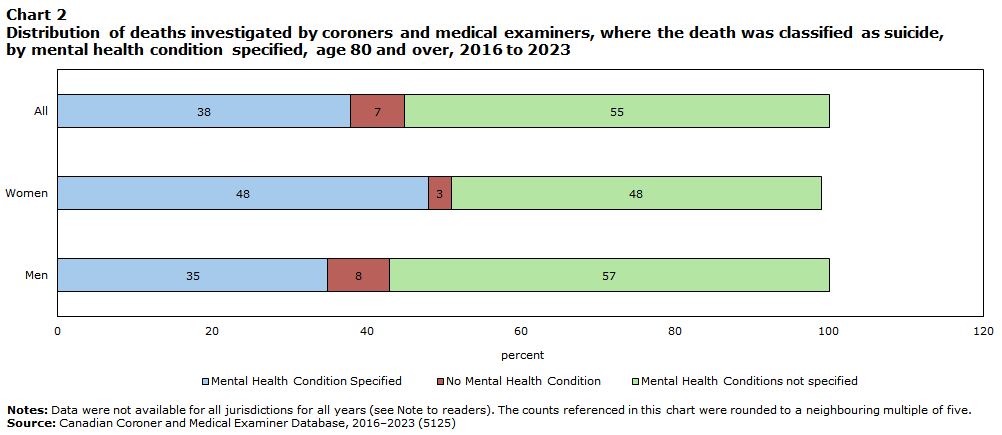
Data table for Chart 2
| All | Women | Men | |
|---|---|---|---|
| percent | |||
| Notes: Data were not available for all jurisdictions for all years (see Note to readers). The counts referenced in this chart were rounded to a neighbouring multiple of five. Source: Canadian Coroner and Medical Examiner Database, 2016–2023 (5125) |
|||
| Mental Health Condition Specified | 38 | 48 | 35 |
| No Mental Health Condition | 7 | 3 | 8 |
| Mental Health Conditions not specified | 55 | 48 | 57 |
Health-related and psychosocial circumstances reported among adults aged 80 years and older who died by suicide
Suicide can result from a complex combination of personal, social, financial, and cultural factors that change over a person’s lifetime. According to CCMED data, select factors were identified among adults aged 80 years and older who died by suicide. Deteriorating physical health was the most commonly reported circumstance by coroners and medical examiners, identified for nearly half (47%) of deceased individuals. Deteriorating physical health includes factors such as worsening health, functional decline, or chronic illness. Other more commonly reported factors included loss of a loved one (14%), loss of mobility (10%), social isolation (7%) and family conflict (4%). Factors such as financial and housing insecurity were less commonly reported (3%).
The proportion of reported circumstances varied slightly by sex. Factors including deteriorating physical health and loss of mobility were more commonly reported among men aged 80 years and older who died by suicide. In comparison, social isolation was more commonly reported among women than among men.
In 20% of deaths, two or more of these circumstances were identified, highlighting the complex and multifactorial nature of suicide among older adults. This finding is consistent with the broader literature, which recognizes suicide as a multifaceted phenomenon shaped by the interaction of multiple factors, including sociodemographic, health, psychological, and social circumstances, rather than any single contributing factor.
Detailed review of CCMED narratives revealed additional factors and themes not captured in the categories derived. Some of these themes included fear of transitioning to long-term care, stress and isolation from COVID-19, concern about a spouse entering long-term care, caregiver burnout, fear of losing a driver’s license, and overall declining quality of life.

Data table for Chart 3
| Factors | Yes | No | Not Specified |
|---|---|---|---|
| percent | |||
| Notes: Data were not available for all jurisdictions for all years (see Note to readers). The counts referenced in this chart were rounded to a neighbouring multiple of five. Source: Canadian Coroner and Medical Examiner Database, 2016–2023 (5125) |
|||
| Financial/Housing Insecurity | 3 | 1 | 96 |
| Family conflict | 4 | 0 | 95 |
| Social isolation | 7 | 2 | 91 |
| Loss of mobility | 10 | 0 | 90 |
| Loss of loved one | 14 | 0 | 86 |
| Deteriorating physical health | 47 | 1 | 52 |
A suicide note was reported at the scene of 28% of suicide deaths among people 80 years and older
A suicide note was documented at the scene in at least 28% of suicides among adults 80 and older. This is consistent with previous research which found that across all age groups, suicide notes are left by approximately 15% to 38% of people who died by suicide (Furquan et al., 2019). Suicide note information was not specified in the CCMED for 51% of suicide deaths among people aged 80 years or older. The presence of a suicide note seemed to be relatively similar across both sexes, with a slightly higher proportion among women (33%) than men (27%).
Data
Data for this analysis were obtained from the Canadian Coroner and Medical Examiner Database (CCMED). The CCMED was developed in 2008 by Statistics Canada in collaboration with the 13 provincial and territorial chief coroners and chief medical examiners and the Public Health Agency of Canada. Currently, it combines death investigation data from all provincial and territorial databases, except Manitoba. The database contains detailed information on the demographics of the deceased person (e.g., age, sex, date of death, province or territory), cause and manner of death, related health conditions and circumstances of death.
The CCMED contains structured fields to capture the age and sex of the decedent, the place of the death, the province or territory in which the investigation took place, and the date of death or the date when the body was found. Additional details are available in unstructured text in the cause, condition, and narrative reports. Together, the place of death type, circumstance fields, and the unstructured text were used to abstract the data for this analysis.
Counts of suicide occurring in Manitoba were obtained using the Canadian Vital Statistics Database (CVSD), as such additional circumstance information was not available for Manitoba.
Link to the CCMED: Surveys and statistical programs - Canadian Coroner and Medical Examiner Database (CCMED)
Notes
Medical Assistance in Dying (MAiD) was legally implemented in Canada starting in June 2016 (Government of Canada, 2026). Cases in which the death occurred through MAiD were excluded (n=185). This left a cohort of 1345 suicide deaths among adults aged 80 and older for analysis.
The category ‘unspecified’ reflects the percentage of missing information for a given factor (i.e., percentage of information on suicide ideation that was missing from CCMED). Therefore, the proportions presented should be interpreted as a minimum prevalence.
In addition, as CCMED is a minimum database (i.e., includes a select number of more commonly reported death investigation variables from across Canada), it may not include all the information that is reported in each provincial or territorial case management system. As such, circumstances such as social isolation, loss of spouse, family conflict, may not be consistently collected or reported across jurisdictions.
Counts referenced in this release were rounded to a neighbouring multiple of five.
References
Bachmann, S. (2018). Epidemiology of suicide and the psychiatric perspective. International Journal of Environmental Research and Public Health, 15(7), Article 1425. https://doi.org/10.3390/ijerph15071425
Conejero, I., Olié, E., Courtet, P., & Calati, R. (2018). Suicide in older adults: Current perspectives. Clinical Interventions in Aging, 13, 691–699. https://doi.org/10.2147/CIA.S130670
Furqan, Z., Sinyor, M., Schaffer, A., Kurdyak, P., & Zaheer, J. (2019). “I Can’t Crack the Code”: What Suicide Notes Teach Us about Experiences with Mental Illness and Mental Health Care. The Canadian Journal of Psychiatry, 64(2), 98–106. https://doi.org/10.1177/0706743718787795
Government of Canada. (2026). Medical assistance in dying: Legislation in Canada. https://www.canada.ca/en/health-canada/services/health-services-benefits/medical-assistance-dying/legislation-canada.html
Hawton, K., & Williams, K. (2002). Influences of the media on suicide. BMJ, 325(7377), 1374–1375. https://doi.org/10.1136/bmj.325.7377.1374
Nock, M. K., Borges, G., Bromet, E. J., Alonso, J., Angermeyer, M., Beautrais, A., et al. (2008). Cross-national prevalence and risk factors for suicidal ideation, plans and attempts. British Journal of Psychiatry, 192(2), 98–105. https://doi.org/10.1192/bjp.bp.107.040113
Public Health Agency of Canada. (2023, January 9). Suicide in Canada: Key statistics (infographic). https://www.canada.ca/en/public-health/services/publications/healthy-living/suicide-canada-key-statistics-infographic.html
Statistics Canada. (2019, April 29). Canadian Coroner and Medical Examiner Database, 2006 to 2017. /n1/daily-quotidien/190429/dq190429a-eng.htm
- Date modified: