
Vehicle registrations, 2025
Released: 2026-09-22
27.6 million
2025
3.1% 
(annual change)
Highlights
In 2025, a total of 27.6 million road motor vehicles were registered in Canada, up 3.1% from the previous year. More than 9 in 10 vehicles (91.7%) were light-duty vehicles (LDVs), and 6.5% of this share was electric vehicles (EVs). Among registered light-duty EVs, the United States was the leading country of assembly, accounting for 35.6%, followed by Japan (20.8%) and Canada (14.9%). China (3.6%) ranked seventh, and more than 9 in 10 China-assembled EVs were battery electric vehicles (BEVs).
Visit the Light and medium-duty vehicle registrations: Interactive dashboard to explore the data more fully.
Total registrations continue to rise
In 2025, there were 27.6 million road motor vehicles registered in Canada, up 3.1% (+827,153 vehicles) from the previous year. This increase was driven by Ontario (+572,241 vehicles), stemming partly from changes to Ontario's automatic registration renewal system, following its implementation in July 2024 (See Note to readers).
LDVs—including passenger cars, multi-purpose vehicles, pickup trucks and vans—accounted for 91.7% of all registrations and increased by 772,602 vehicles (+3.1%) from 2024 to reach 25.3 million vehicles in 2025. Registrations of medium-duty vehicles rose 3.8%. BEVs recorded the fastest growth among medium-duty vehicles, more than quadrupling from 994 to 4,368 vehicles. This increase was driven by larger sport utility vehicles and pickup trucks, coinciding with the introduction of BEV models in these segments.
In 2025, registrations of heavy-duty vehicles edged up 0.2% from 2024. Class 8 vehicles—those with a gross vehicle weight rating above 14 969 kilograms—accounted for most (87.7%) of the heavy-duty vehicle fleet. The number of buses edged up 0.9% in 2025.
Multi-purpose vehicles further increase their share
Within the LDV fleet, registrations of multi-purpose vehicles—including sport utility vehicles and crossovers—rose 8.3% from 2024 to 11.1 million in 2025. This marked the fourth consecutive year that registrations of multi-purpose vehicles surpassed those of passenger cars.
Multi-purpose vehicles accounted for 44.0% of LDV registrations in 2025, up from 29.8% in 2017, when comparable data first became available. Over the same period, the share of passenger cars declined from 45.0% to 33.3%.
Chart 1

Number of light-duty vehicles, by type, Canada, 2017 to 2025
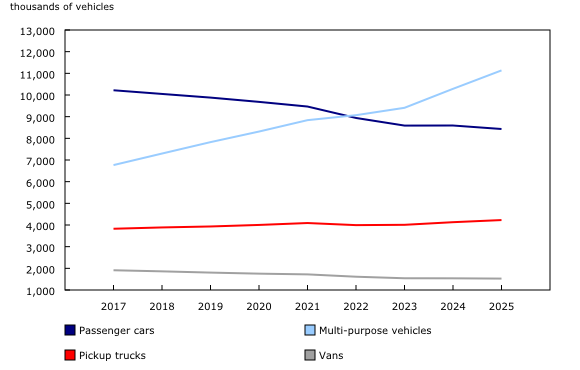
According to 2025 data for new motor vehicle registrations, close to two-thirds (63.3%) of new vehicles registered that year were multi-purpose vehicles, up from 42.1% in 2017. This continued shift away from passenger cars is consistent with changing consumer preferences toward the utility and versatility offered by multi-purpose vehicles.
All provinces and territories recorded year-over-year increases in LDV registrations in 2025, ranging from 0.3% in Newfoundland and Labrador to 6.2% in Ontario. More than one-third (37.0%) of all LDV registrations in Canada were in Ontario. Nationally, registrations of light-duty pickup trucks rose 2.4%, while van registrations edged down 0.9%.
Hybrid electric vehicles lead electric vehicle registration growth in 2025
In 2025, EVs accounted for 6.5% of LDV registrations, compared with 5.2% in 2024, including 772,562 hybrid electric vehicles (HEVs), 623,481 BEVs and 251,520 plug-in hybrid electric vehicles (PHEVs).
Chart 2
Annual growth in the number of light-duty vehicle registrations by selected fuel type, Canada, 2018 to 2025

Growth patterns have differed across EV types since 2017. In 2025, HEV registrations recorded the strongest increase among the three EV types, rising 31.8%, which was broadly similar to the pace of growth recorded in 2024. HEV growth was more moderate earlier in the series but has strengthened in recent years. BEV registrations rose 27.9% in 2025, a slower pace than in 2024 (+48.8%). BEVs experienced particularly rapid growth earlier in the series, including annual increases of more than 80% in both 2018 and 2019, before growth moderated in more recent years. PHEV registrations increased 27.3% in 2025, slower than the 36.3% increase in 2024. Registrations of the three EV types combined rose by 376,386 in 2025, an increase of 29.6% from 2024.
BEVs and PHEVs, classified as zero-emission vehicles (ZEVs), made up 3.5% of LDV registrations in 2025, up 27.7% from 2024, following a 44.9% increase from 2023 to 2024. The slower pace of growth in ZEV registrations in 2025 occurred during a period of evolving policy design. This included the suspension of federal incentives for ZEVs in January 2025 and the reduction of rebates offered under Quebec's Roulez vert program, changes that likely contributed to lower ZEV demand in 2025. In September 2025, the federal government also announced that the 20% ZEV sales requirement for 2026 would be waived.
Despite the continued increase in EV registrations, gasoline-powered LDVs accounted for about 9 in 10 registrations (90.8%) in 2025, down from 96.0% in 2017. The proportion of diesel-powered LDVs also declined, from 3.1% in 2017 to 2.6% in 2025.
Electric vehicle assembly origins in the Canadian fleet
By 2025, EVs registered in Canada had been assembled in Canada and 13 other countries. The United States was the leading country of assembly, accounting for 35.6% of registered light-duty EVs, followed by Japan (20.8%) and Canada (14.9%). The distribution of EVs by fuel type differed between the United States and Canada, highlighting distinct assembly patterns across North America. BEVs represented 51.4% of EVs assembled in the United States, while HEVs accounted for 96.0% of those assembled in Canada.
As the global trade environment evolved throughout 2025 and since the beginning of 2026, Canada and China announced a new strategic partnership in January 2026 that allows up to 49,000 Chinese EVs at the "most-favoured-nation" tariff rate of 6.1%, as opposed to the 100% surtax imposed in 2024. To provide background, China ranked seventh among countries of assembly, accounting for 3.6% of registered light-duty EVs in 2025. A total of 59,565 China-assembled light-duty EVs were registered in Canada, and more than 9 in 10 of them were BEVs.
Following the Canada-China strategic partnership, new motor vehicle registrations show a higher proportion of newly registered ZEVs assembled in Asia, reaching 54.6% in the second quarter of 2026, the highest level since the third quarter of 2024. In comparison, the share assembled in North America declined from 79.4% in the first quarter of 2017 to 27.3% in the second quarter of 2026. These data will help measure how recent changes in tariff treatments are reflected in the composition of newly registered ZEVs in Canada. Additional results by continent of assembly are available in the new motor vehicle registrations data table.
Note to readers
Please note that this is the final "Vehicle registrations" release. To learn how the agency is adapting to continue delivering quality data that Canadians rely on, visit Delivering trusted data through change.
The annual count of registered vehicles is based on administrative files provided by each province and territory. Registered vehicles are road motor vehicles including light-duty, medium-duty and heavy-duty vehicles as well as buses, motorcycles and mopeds. Each iteration of these files contains updated information.
Beginning in July 2024, Ontario implemented an automatic registration renewal program for passenger vehicles, light-duty trucks, motorcycles and mopeds. Because the program was introduced partway through 2024, only part of its effect was captured in Statistics Canada's 2024 annual estimate, while the 2025 estimate reflects a full year under the automatic renewal system. As a result, the 2024 estimate is comparatively understated and explains part of the year-over-year growth in 2025.
Definitions:
Gross vehicle weight rating (GVWR): the maximum weight a vehicle is designed to carry. Manufacturers set the GVWR.
Light-duty vehicles refer to vehicles with a GVWR less than or equal to 4,536 kilograms (0 to 10,000 pounds) and include GVWR classes 1 and 2.
Medium-duty vehicles refer to vehicles with a GVWR from 4,536 kilograms to 11,793 kilograms (10,001 to 26,000 pounds) and include GVWR classes 3, 4, 5 and 6.
Heavy-duty vehicles refer to vehicles with a GVWR greater than or equal to 11,794 kilograms (26,001 pounds and greater) and include GVWR classes 7 and 8.
Battery electric vehicles are vehicles powered solely by a rechargeable battery pack and produce zero tailpipe emissions.
Plug-in hybrid electric vehicles are vehicles with a rechargeable battery pack and an internal combustion engine. They run on electric power until the battery is drained and then the internal combustion engine takes over for propulsion.
Zero-emission vehicles are battery electric vehicles or plug-in hybrid electric vehicles that have the potential to produce no tailpipe emissions.
Hybrid electric vehicles have a rechargeable battery pack providing an extra boost of power, in addition to having an internal combustion engine. They are not considered part of zero-emission vehicles.
The Transportation Data and Information Hub, a web portal developed jointly by Statistics Canada and Transport Canada—provides Canadians with online access to comprehensive statistics and measures on the country's transportation sector.
Contact information
For more information, or to enquire about the concepts, methods or data quality of this release, contact us (toll-free 1-800-263-1136; 514-283-8300; infostats@statcan.gc.ca) or Media Relations (statcan.mediahotline-ligneinfomedias.statcan@statcan.gc.ca).
- Date modified: